10th September 2024
Once every four to five years, the primary mirror of the Liverpool Telescope requires re-aluminising. This process is necessary to continue providing the best quality images possible.
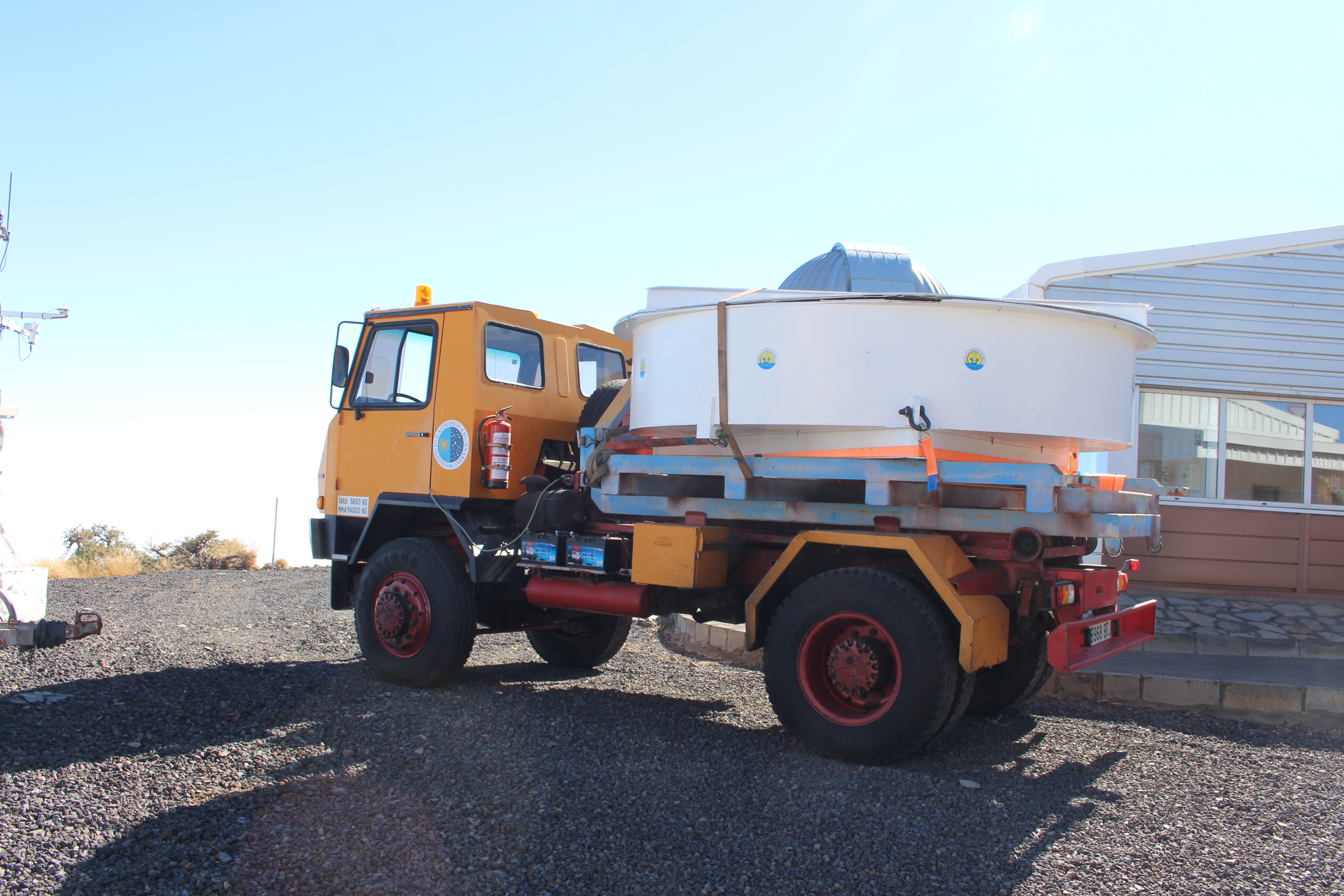
So, what exactly is re-aluminising? In simple terms, it’s the process of restoring the mirror’s reflective coating by applying a fresh layer of aluminium. Dust and dirt gradually builds up on the surface, and that grime starts to interfere with the mirror’s ability to reflect light. For the Liverpool Telescope, which operates in an open enclosure, this problem is even more pronounced as the design leaves the mirror more exposed to weather factors, resulting in a dirty mirror that can’t reflect as many photons (tiny particles of light that allow us to capture images of the cosmos). When fewer protons are reflected, the images the telescope produces become less crisp, and its ability to detect distant objects is reduced. That’s why re-aluminising is such a vital part of the telescope’s maintenance, ensuring the instrument stays in peak condition. Re-aluminising the LT’s primary mirror is a complex operation that requires a lot of advance planning. The mirror is massive and heavy; it weighs 1.25 tonnes so just moving it is a task in itself! Before the mirror can be moved all the instrumentation must be taken off the bottom of the telescope. The LT houses all its instrumentation at the Cassegrain focus (at the base of the telescope structure) and they can be easily activated during the night by deploying the sciencefold mirror (a 45 degree mirror house in the acquisition and guidance box) which directs the light to the desired instrument. The instrumentation has to be taken off in order to remove the mirror from the bottom of the telescope. A crane is used to lift it out of the telescope structure and secure it safely in a specially designed travel container. Once secured, the mirror is transported to the William Herschel Telescope recoating plant on the mountaintop.
The IAC lorry carrying the LT mirror safely to the recoating chamber
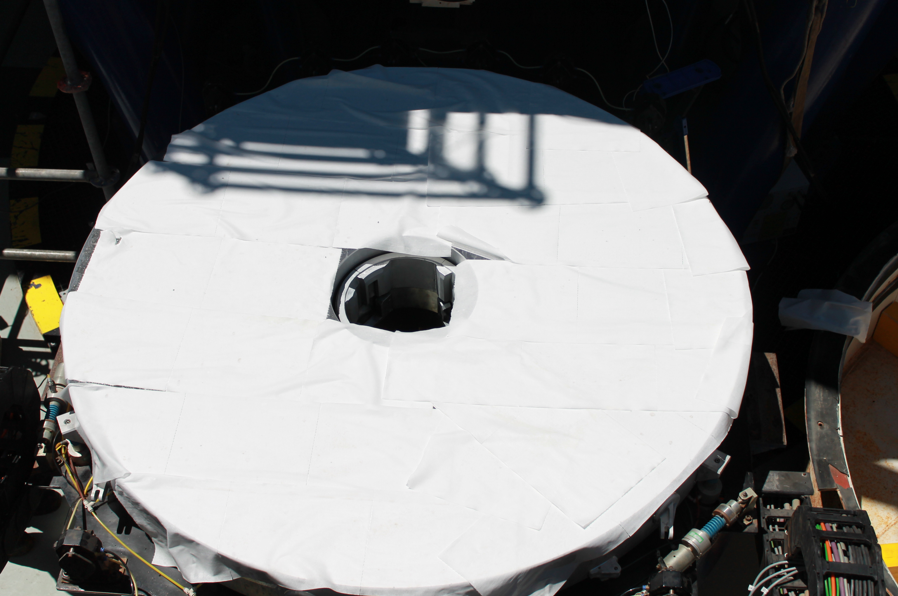
One of the major hazards here is the mirror itself which is powered to focus light. This means that any sunlight that reflects off the mirror could generate a lot of heat. It would act like a 2 metre diameter magnifying glass! To mitigate this risk the mirror is fitted with 'lens tissues' before it is removed from the enclosure. This prevents sunlight from reflecting off the mirror surface.
Lens tissues covering the LT mirror to prevent sunlight from reflecting off the surface.
At the re-aluminising plant, the mirror is thoroughly cleaned to remove surface residue such as dust that has blown over from the Sahara desert. Hydrochloric acid is used to remove the old aluminium coating before it is hand-polished using polishing cloths. Once clean and dried, the mirror is loaded into an aluminium coating chamber and put under vacuum for a new layer of aluminium to be applied. In total, the re-aluminising process takes 3 days, however the whole activity (disassembly, reassembly, routine maintenance etc) takes 2 weeks during which the telescope is off-sky, meaning it’s unable to carry out any observations. It is a necessary activity, but one that prevents the telescope from being able to observe and thus collect data. To improve this process in the future, the upcoming NRT is being designed with maintenance in mind; the 18 individual segments are lighter, smaller and easier to move with a smaller crane. Spares will be available so that when the mirror segments are removed for realuminising, a replacement can be used immediately, meaning there is little to no time offsky.
The team flex their muscles as they push the mirror back under the telescope
Supervising this intricate procedure is Stuart, our Engineering Manager, whose expertise is invaluable in ensuring everything runs smoothly. Alongside him, members of the LT and NRT teams Adam Garner, Ali Ranjbar, João Bento, Chloé Miossec and Chris Mottram worked together to make sure the telescope is restored to optimal performance.
News item written by Carmen and Sofía de Cos.